
Tutorial · Learning on Graphs Conference (LoG) 2026

Learning with Covariance Matrices

Foundations, Applications to Network Neuroscience and Recent Developments

  • Friday, November 20, 2026
  • 15:30 – 18:00 EST
  • Northeastern University, Boston

Overview

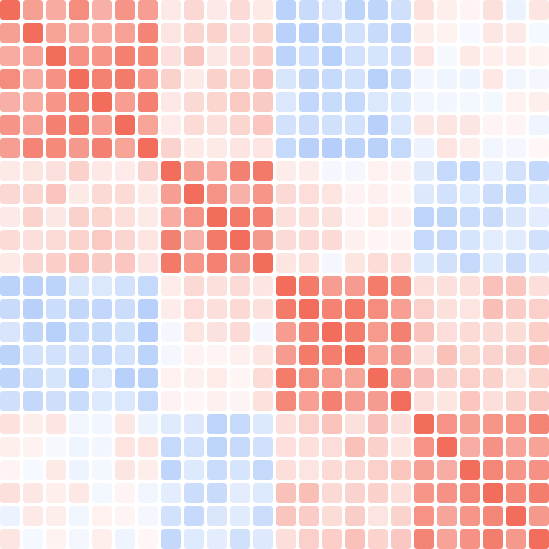
Covariance matrices capture the redundancies between the features of a dataset: brain regions that activate together, stock prices that fluctuate in tandem, traffic volumes that are correlated across intersections. They are a cornerstone of multivariate data analysis, most prominently through principal component analysis (PCA). Yet PCA is a fixed, task-agnostic linear transformation, and learning from sample covariance matrices raises four key challenges: how to use covariance information for representation learning on a downstream task; whether inference is stable to the finite-sample perturbations of the estimated covariance; whether models are transferable across datasets that describe the same phenomenon with a different number of features; and how to make learning interpretable.

This tutorial treats the covariance matrix as a relational inductive bias, a data-driven graph, and introduces coVariance neural networks (VNNs): graph neural networks that operate on sample covariance matrices. Starting from the connection between PCA and the graph Fourier transform, we show that coVariance filters implicitly perform PCA-based inference without computing eigenvectors, and that, unlike PCA, VNNs are provably stable to covariance estimation errors and transferable across scales. We then show how these properties enable principled, anatomically interpretable brain age gap prediction in network neuroscience, and we illustrate how using pairwise statistics as inductive biases underpins a broader set of data processing methods beyond VNNs, including sparse VNNs, precision neural networks and covariance scattering transforms.

Topics covered

  1. PCA and the graph Fourier transform PCA-based inference implemented as a polynomial graph filter over the covariance matrix.
  2. coVariance neural networks (VNNs) coVariance filters as convolutional operators, and VNNs as their layered composition with nonlinearities.
  3. Theory of VNNs: stability and transferability Robustness to finite-sample covariance estimates, scale-free models and graphon limits.
  4. Application: principled brain age gap prediction with VNNs Anatomically interpretable and explainable biomarkers of neurodegeneration.
  5. Variants of VNNs Sparse VNNs, precision neural networks and covariance scattering transforms.

Key takeaways

  1. The covariance matrix can serve as a relational inductive bias for representation learning. By addressing the key challenges of learning with covariances, VNNs:

    • improve generalization and parameter efficiency compared with standard neural networks;
    • achieve better stability to finite-sample estimation errors than PCA;
    • transfer across dimensionalities and resolutions;
    • address methodological and conceptual obscurities in brain age gap prediction.
  2. The VNN principles define a more general framework that maintains their key advantages and encompasses:

    • estimators beyond the sample covariance (e.g., thresholded or regularized covariances, and the precision matrix via the graphical lasso);
    • architectures beyond GNNs (e.g., scattering transforms for untrained processing);
    • task-aware structure estimation.

Speakers

Saurabh Sihag

Saurabh Sihag

University at Albany

Saurabh Sihag is an Assistant Professor in the Department of Electrical and Computer Engineering at the University at Albany. He was previously a postdoctoral researcher in the Department of Electrical and Systems Engineering at the University of Pennsylvania. His research interests include statistical inference and machine learning over graph-structured data and network neuroscience.

Andrea Cavallo

Andrea Cavallo

Delft University of Technology

Andrea Cavallo is a PhD candidate at the Faculty of Electrical Engineering, Mathematics and Computer Science, Delft University of Technology, the Netherlands. His research focuses on relational machine learning through higher-order networks and statistical moments, as well as diffusion models.

Other organizers

Gonzalo Mateos

Gonzalo Mateos

University of Rochester

Gonzalo Mateos is a Professor with the Department of Electrical and Computer Engineering at the University of Rochester, and the Associate Director for Research at the Goergen Institute for Data Science and Artificial Intelligence. His research interests lie in statistical learning from complex data, network science, decentralized optimization, and graph signal processing.

Website
Elvin Isufi

Elvin Isufi

Delft University of Technology

Elvin Isufi is an Associate Professor in the Faculty of Electrical Engineering, Mathematics and Computer Science at TU Delft, where he also co-directs AIdroLab, the TU Delft AI Lab on graph-based learning for water networks. His research interests are in signal processing and machine learning for graphs and other topological structures, with applications in critical infrastructure networks, recommender systems, and sensor networks.

Website
Alejandro Ribeiro

Alejandro Ribeiro

University of Pennsylvania

Alejandro Ribeiro is a Professor of Electrical and Systems Engineering at the University of Pennsylvania, where he has been since 2008. His research interests include statistical signal processing for networks and networked phenomena, structured representations of networked data, graph signal processing, network optimization, robot teams, and networked control.

Website

Program

  1. Introduction: learning with covariance matrices
  2. PCA and the graph Fourier transform
  3. coVariance neural networks (VNNs)
  4. Theory of VNNs: stability and transferability
  5. Application: principled brain age gap prediction with VNNs
  6. Variants of VNNs
  7. Conclusions, future directions & Q&A

Tutorial materials

Slides

[Link to slides PDF]

Code

Hands-on Google Colab notebook for the tutorial. To use it:

  1. Open the notebook with the button below.
  2. Create your own copy: in Colab, choose File → Save a copy in Drive (requires a Google account).
  3. Run your copy: choose Runtime → Run all, or run the cells one by one.

Related tutorial articles

  • Companion article Learning with Covariance Matrices: Principal Component Analysis Meets Learning with Graphs S. Sihag, A. Cavallo, E. Isufi, G. Mateos, and A. Ribeiro IEEE Signal Processing Magazine, accepted for publication, 2026. arXiv PDF
  • Disentangling Neurodegeneration with Brain Age Gap Prediction Models: A Graph Signal Processing Perspective S. Sihag, G. Mateos, and A. Ribeiro IEEE Signal Processing Magazine, vol. 42, no. 4, pp. 58–77, 2025. IEEE Xplore arXiv

Additional material

Papers

coVariance neural networks: foundations and theory

  1. S. Sihag, G. Mateos, C. McMillan, and A. Ribeiro, “coVariance neural networks,” in Proc. Conference on Neural Information Processing Systems (NeurIPS), 2022. arXiv Code
  2. S. Sihag, G. Mateos, C. McMillan, and A. Ribeiro, “Transferability of covariance neural networks,” IEEE Journal of Selected Topics in Signal Processing, 2024. arXiv
  3. S. Khalafi, S. Sihag, and A. Ribeiro, “Neural tangent kernels motivate cross-covariance graphs in neural networks,” in Proc. International Conference on Machine Learning (ICML), 2024. OpenReview

Network neuroscience and brain age prediction

  1. S. Sihag, G. Mateos, C. McMillan, and A. Ribeiro, “Explainable brain age prediction using coVariance neural networks,” in Proc. Conference on Neural Information Processing Systems (NeurIPS), 2023. OpenReview arXiv
  2. S. Sihag, G. Mateos, and A. Ribeiro, “Explainable brain age gap prediction in neurodegenerative conditions using coVariance neural networks,” in Proc. IEEE International Symposium on Biomedical Imaging (ISBI), 2025. arXiv

Recent developments

  1. A. Cavallo, Z. Gao, and E. Isufi, “Sparse covariance neural networks,” IEEE Transactions on Signal Processing, vol. 74, pp. 3077–3091, 2026. DOI arXiv Code
  2. A. Cavallo, S. Rey, A. G. Marques, and E. Isufi, “Precision neural networks: Joint graph and relational learning,” in Proc. IEEE International Conference on Acoustics, Speech and Signal Processing (ICASSP), pp. 466–470, 2026. arXiv Code
  3. A. Cavallo, S. Rey, A. G. Marques, and E. Isufi, “Joint precision neural networks: Task-aware dependency and predictive learning,” arXiv preprint arXiv:2610.06023, 2026. arXiv
  4. A. Cavallo, A. Raghuvanshi, S. P. Chepuri, and E. Isufi, “Covariance scattering transforms,” in Proc. AAAI Conference on Artificial Intelligence, vol. 40, no. 24, pp. 19925–19933, 2026. arXiv Code
  5. A. Cavallo, A. Raghuvanshi, S. P. Chepuri, and E. Isufi, “Robust covariance neural networks,” in Proc. Asilomar Conference on Signals, Systems, and Computers, 2025. IEEE Xplore
  6. A. Cavallo, M. Sabbaqi, and E. Isufi, “Spatiotemporal covariance neural networks,” in Proc. European Conference on Machine Learning and Knowledge Discovery in Databases (ECML PKDD), pp. 18–34, 2024. DOI arXiv Code
  7. A. Cavallo, M. Navarro, S. Segarra, and E. Isufi, “Fair covariance neural networks,” in Proc. IEEE International Conference on Acoustics, Speech and Signal Processing (ICASSP), pp. 1–5, 2025. IEEE Xplore arXiv
  8. C. Battiloro, A. Cavallo, and E. Isufi, “Covariance filters and neural networks over Hilbert spaces,” in Proc. IEEE International Conference on Acoustics, Speech and Signal Processing (ICASSP), pp. 421–425, 2026. IEEE Xplore arXiv
  9. O. Roy, Y. Moshfeghi, and K. Smith, “Covariance density neural networks,” Transactions on Machine Learning Research (TMLR), 2026. arXiv

Code repositories